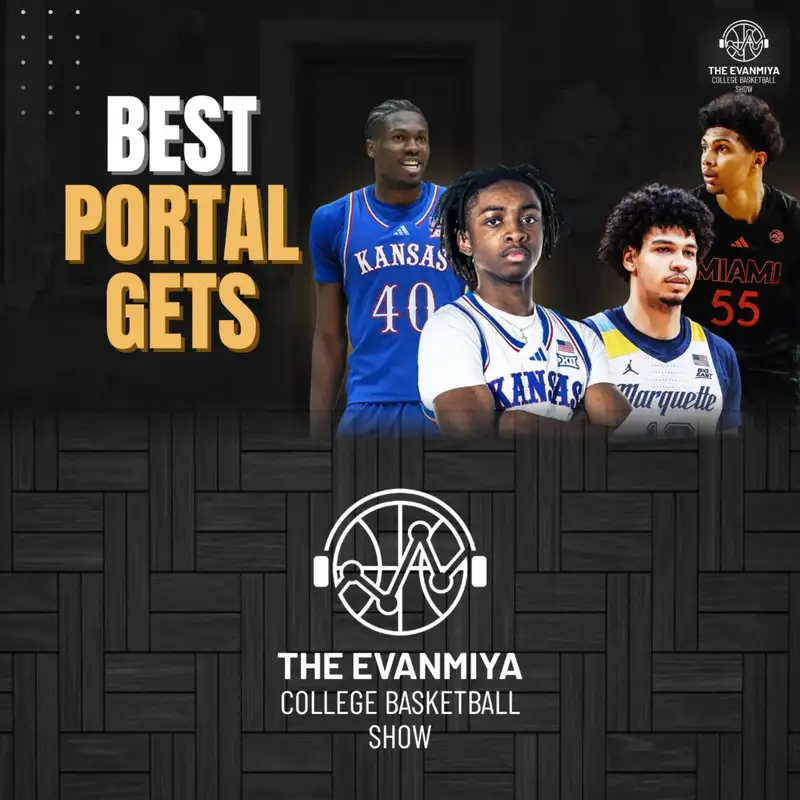
The Best Transfer Portal Additions This Offseason
Evan (00:00)
Hey everybody, welcome to the Evan Mia College basketball show. I'm your host, Evan Mia Kawa, and we've got some more transfer portal stuff to get into today. Another short episode today, what I'm gonna do is, last episode I talked about some of the big NIL transfer portal trends that we've been seeing. Today, I wanted to get into some specific players. I want to look at,
Some of my favorite transfer portal additions that teams have made this off season, most of these guys are gonna be in my top 25 or so rated transfers at evanmia.com if you go look at the portal ranking section. Before I get into specific names, just a little bit of a summary of how I get to these transfer portal projections for players. There are three things that go into predicting how valuable a player will be next season on offense and defense.
relative to all of their players in the country. The first one is your box score statistics. This should be the most obvious category looking at things like your scoring volume, your efficiency, your rebounds, blocks, steals, turnovers, assists, all that good stuff. Looking at it in terms of overall volume, looking at it at a per possession basis, that's ultimately the measurement in which Bayesian performance rating, BPR, the metric I use, comes out in in terms of.
your value to your team in points per 100 possessions better or worse than an average Division I player. So you have your box score statistics, which is the most commonly used category by a lot of people. The second though is your impact on team performance. So regardless of whether you score 30 points per game or three points per game, at the end of the day, coaches want to be putting players on the court who are going to increase their chance of winning by the most and their chance of outscoring opponents by the most points. So...
I also look at ⁓ every single possession that a player is playing over the course of their season or multiple seasons, the outcome of every possession for their team on offense and defense while they're on the court, adjusting for the quality of all other players on the court with them for every possession. So it looks at who are the individual players that you're playing against on this particular possession. How good are they? How bad are they? It also looks at the level of teammates that you're playing.
playing with. So if you're playing with a really bad set of teammates, you would get more credit for things going well than if you're playing with a lot of other great teammates. So that's number two. And number three is historical information for each player. So how have they performed in the previous season or multiple previous seasons if they played in college? If they are a younger player, say a someone who's just finished their freshman or sophomore season in college, what was their recruiting profile coming out of high school? Where were they sort of viewed?
consensus in their class coming into college. And a lot of times that's a good measurement to point to the level of potential that they still have yet to reach in college. And as I mentioned on the last episode, which you can go check out, a lot of times that really does show up in the freshmen to sophomore year leap for a lot of guys who are a four star or a five star coming out of high school, that if they stay in college, they often have a big leap from freshmen to sophomore year. So box score statistics, impact on team performance,
historical information all goes into predicting on offense and defense for every player. How good will they be relative to an average Division 1 player? So if you have a projected BPR much way above zero, that means you're much better than average. And if it's below zero, you're worse than average compared to everyone else in Division 1. So when you look at the transfer portal rankings at Evanmia.com, they are all ranked by that projection. General trend that you may notice is that some of the names that I will have higher
than consensus are guys who are often a little bit more better defensively because most people don't really care about defensive impact or defensive stats as much as they should when evaluating how good a player is overall. So I put more weight, maybe what I would call the more proper weight, into defensive impact than most people. So some of the names that we might talk about today will be guys who wouldn't be regarded as top 25 offensive players in the portal, but they absolutely are defensively.
and that matters a lot into their actual projected impact for their teams. So without further ado, we're gonna go through this list in the order, I think mostly the order in which these players are ranked. I'm not just reading off the top ⁓ eight or so names for my portal rankings. I wanna be a little bit more specific than that in terms of guys that I think either are undervalued or think are really good fits, a combination of all of the above. So we'll spend just a minute or two on each one of these names. I think I've got about eight of these today that we'll go through.
We are gonna start off the top with Flory Budunga, who is the best player in the Portal to have committed to another school at this point. He is the second highest rated player in the Portal.
Evan Mia calm the only one higher is Alan graves from Santa Clara who has yet to do to sign with a team and it's possible He may not even be in college next year if he goes through the NBA draft process for Budunga 610 sophomore from Kansas I think he has been a really really good player for them the last two seasons I think he was their best player overall in this blat this last season even better than Darren Peterson on the course of the year This last season he averaged 13 points nine rebounds two point six blocks
per game. has, Floribedunka has the best projected defensive rating of any player in college basketball next year. So what you'll likely see is when my full pre-season player ratings come out in October, Floribedunka will have the highest defensive BPR projection of any player in college basketball. He is already the reigning Big 12 defensive player of the year, first team all Big 12.
His defensive presence is huge. He obviously is good offensively too, but I think defense is really what puts him towards the very top of this list. Last year, he finished the year 18th nationally in BPR. That was the best on Kansas. I expect that to be even better this year. Offensively, his offensive game isn't that versatile. He can't shoot threes. He's pretty poor at the free throw line, but he is super, super efficient near the rim.
His projected two point per shooting percentage going forward is 66.3%. By the way, if you are watching on YouTube, I have ⁓ graphics of all these different players. A lot of the numbers that we'll be talking about will be on the screen here. One of them that you'll see with Flory Badunga is his two point shooting percentage grade of A plus, a projected shooting percentage of 66.3%. Now obviously he's doing a lot of that near the rim, but.
It is not a given that if your looks are near the rim that you're finishing it as at higher rate as he does. And given the players he's going to be playing with at Louisville this season, I think he'll be up there again. So that's huge. His blocks block rate grade is also really, really good. His projected block rate grade is 9.2 % also in the 99th percentile. And then the last thing that I really like about it as well as it's not just the box score stats. As I mentioned, the team impact stuff is off the charts for Flora Budunga.
This season, his on-off splits, which I'm showing on the screen right now if you're watching on YouTube, Kansas outscored opponents by 34 more points per 100 possessions after adjusting for opponent quality when Badunga was on the floor versus on the bench this year. What that means is they were just kicking teams down when he was on the court and they really, really struggled when he was off. You're not gonna find many players in college basketball with better on-off splits than that.
So not only are his individual numbers good and pointing to even more growth this year at Louisville, but also his impact on team performance is really high. And that's why I think even though he's being heralded as probably the best transfer this year, I think in still some ways his impact for Kansas this year was underrated. So I'm very excited to see what he does in a Louisville uniform.
All right, next up is a Caden Lewis, 6'2 freshman from Villanova who is going to be transferring to Miami, Florida. And he was a top 50 prospect coming out of high school last season for Villanova, averaged 12.5 assists to steals per game. And he is one of these players who was really, really solid as a freshman. As I talked about, he was a top 50 recruit coming out of high school so we know that he can reach an even higher level.
And that is a lot of what goes into his projection as being the fifth best transfer in the portal as of right now. And that's a huge commitment for Miami. Let's go into a little bit more detail here because right now his projected BPR for next season is 7.1.
if you look at where he actually finished the year in BPR, was only a plus 5.1. So that's a pretty big jump from 5.1 to 7.1. It's one of the bigger jumps that you'll find from end of season BPR.
to predicted rating for next season.
A lot of that comes back down to the underlying box score statistics are good, but the freshman to sophomore year leap for guys like Akaden Lewis, who stay in college freshman to sophomore season, showed a lot of flashes, maybe weren't quite a finished product, but showed a lot of signs. A lot of times these guys, when they come back to college, they're much, much better in their sophomore year. So that is a lot of what is accounted for here in his profile.
The best attribute by far for Caden Lewis is his playmaking, A plus grade in that department, 99th percentile, and that is a combination of his assist rate projection and his turnovers projection. His assist rate projection is in the 99th percentile. His turnover rate projection is in the 20th percentile, which means he's in the top 20 % of players who turn the ball over the most. That is very, very typical for a guard who is passing as much as he is.
And so that turnover grade does not really concern me at all. And that's why his overall playmaking grade is still so high. He is growing as a scorer. He has got a B grade in scoring volume. His efficiency is just okay. He's above average in two point shooting. He's not a great three point shooter yet, but overall he's growing in that department. And I think we'll see more of that this year at Miami. And when you pair him with Shelton Henderson, who's coming back to Miami and you got Santo Surreal, who's going to be a great interior presence and someone who
Akaiden Lewis will be passing the ball to a lot. I think that's a really, really good ⁓ group of players there for Jay Lucas and Miami as they're kind of building the rest of the roster. So I really, really like Akaiden Lewis and I'm looking forward to seeing how well he plays this season.
All right, next name is Sananda Frew, who's going from Louisville to Marquette. Now this is one of the more contentious ratings that I have because I've had many a Louisville fan come in my mentions and say that this projection of him being the fourth best player in the portal does not align at all with the eye test, if you will. So it's gonna be very interesting to see how this plays out this year. Here is why Sananda Frew is rated so high. Part of it is in his first season in college, he was pretty good.
and there's a lot of potential that's still to be reached with him based on all of the pedigree that he had coming into playing college. ⁓ Last season he averaged 9.6 rebounds, 1.4 blocks in just 22 minutes per game, so he didn't play as much. ⁓ He's German, played for the German national team, and 6'11 as a junior. So his first season was solid, not spectacular, but he's got a lot of tools and I think is one of these guys who has a lot of growth that he can find.
and hopefully we'll do so at Marquette. Now, here's what the underlying metrics show about why I like him so much. First of all, he has the very best two point percentage projection from anybody in the portal at 71.5%. Now, once again, like Flory Badunga, he doesn't have a lot of other offensive assets and a lot of his shots aren't at the rim. But if you look at everyone in Division 1 of all...
All of this last season in terms of where they finished the season and their overall two point percentage grade at Evanmia.com, only James Scott and Malik Brown had a higher projected two point percentage going forward than Sinanda Frew. It is super rare to be able to finish with that level of efficiency, even though his looks are quote unquote easy. A lot of other players have those same kinds of looks and are not able to put up these types of numbers. So that in and of itself means that you're always getting high quality looks when he's shooting the ball. That's awesome. The blocks.
Also look really good here. He has an A- grade in blocks, 97th percentile in terms of his projected block rate going forward. Solid rebounder as well, A- overall in rebounding. But then, if we look at some of the other, just like where he stacked up on Louisville this year, because this is where some of the criticism comes from of over the course of the season, he started playing less and less and it seemed like there wasn't as much trust in him. On the course of the season,
All of the Louisville players in terms of where they ranked in BPR, now granted there were a lot of them who were very close. Sinanda Frew ⁓ finished sixth on Louisville in BPR and Louisville was a good team this year. So he was very solidly middle of the pack, the second best defensive BPR grade amongst the team. And ⁓ that ended up being I think 163rd nationally. He was fourth in box BPR. So box BPR.
is a value metric that only is looking at your box score statistics, none of the other team impact stuff or recruiting profile stuff. Just purely how good were your box stats? It's my own more accurate version of box plus minus. He was fourth on the team in box BPR, so that's good. When you look at the team impact stuff, here I'm basically looking at every single player on Louisville sorted by adjusted team efficiency margin. What this means is it's a measure of how good the team played
when you were on the court in terms of how many more points per 100 possessions you scored than your opponent, adjusted for opponent quality strength. So this is a measure of saying regardless of how good anyone looks statistically, which players were the most effective in terms of their impact on team performance. So Nanda Fru's adjusted team efficiency margin of 27.7 was second best on the team behind Ali Khalifa. So basically the box score statistics were pretty good.
The team impact metrics suggest that he was one of the best players in terms of his pure on-court impact for Louisville. So all of that to me looks positive on the course of the season. And then you look at how good some of his underlying skill grades are. I just think there's a lot to like here. I think in a different system, he might be better. So I do have a lot of optimism for what Fru can accomplish at Marquette. And just for Marquette, getting him is big because, you know, Marquette notoriously over the last several seasons.
has not been very good at getting transfers. This is a big coup for them and I think is a really, really solid piece for the roster that Shaka Smart is building.
All right, next we have Isaiah Johnson, 6'1 freshman guard from Colorado, who is a three star out of high school, transferring to Texas. Had a really, really good freshman year for a Colorado team that wasn't that noteworthy this season. 17 points per game, three assists, three rebounds per game, and he clocks in as the sixth best transfer on the board at evanmia.com. Specifically, his offensive game I think will be.
Awesome this year and take another big leap from what was already a really really good freshman season from him Again, another example of one of these guys who was really good as a freshman who will take a leap as a sophomore He has the second best offensive transfer rating of any player in the portal behind Alan Graves So in other words if you sort all the players in the portal by their offensive projection, he's the second best So I think he's gonna be lights out for this Texas team He's a really really good scorer
Very solid in terms of his scoring volume and all of his individual shooting percentage grades, three point shooting, two point percentage, free throw percentage are all better than average, if not significantly better than average, especially when it comes to three point shooting and free throws. He's a good playmaker as well. One of the things that sticks out to me is for someone who has the ball as much in his hands as he does, he has a very good turnover rate, which means he's not turning the ball over hardly at all for someone who is getting the ball that much.
So I really like that part. I mentioned the shooting efficiency. 92nd percentile in three point shooting grade, 89th percentile in free throw grade. So all of the offensive stuff really sticks off the board. Defensively he's okay, but offensively one of the best players in the portal and why I think he's gonna be one of the better pieces for Texas this season.
All right, next we have Leroy Blyden Jr. Freshman guard from Toledo who is transferring to Kansas. 6'1", three-star out of high school. This last season averaged 16 points, four and a half cysts, four rebounds, and almost two steals per game. Blyden is the highest rated mid-major guard that I have in the entire portal. I think this is a awesome, awesome get for Kansas team that is still trying to figure out exactly what their roster's gonna look like next year.
⁓ I really, really like what he showed in his first season at Toledo. Again, another freshman who I'm expecting a big sophomore leap for. He finished the season with the fourth best BPR in the Mac conference and now clocks in as the 12th best transfer in the portal at EvanMia.com. He's a pretty good scorer and a lot of that comes down to he is a very good three point shooter.
projected 38 % shooter next season. That's in the 95th percentile nationally and he's in the 91st percentile in his free throw shooting grade. So both of those are awesome for someone who has the ball as much in his hands as he does, similar to Isaiah Johnson as we talked about. He rarely turns the ball over, just 50th percentile, which compared to all players in division one, that's good for a guard who has the ball in his hands as much as he does. And he's fairly good. He has a B plus grade in assist rate projection. So
That's very good too. He also has a very good steel rate grade as well. He's a B plus in steels. And one of the other things that pointed to his strong impact on Toledo, especially offensively, is he also had really good on-off splits. If you look at that at evanmia.com, he was plus 14 in his on-off splits margin, which basically means Toledo was outscoring opponents by 14 more points per 100 possessions when he was on the court.
and that was a plus 12 on the offensive side. So a lot of that came on the offensive side of the ball. So not only are his individual box score statistics offensively very good, but Toledo also was playing a lot better offensively when he was on the court. All of that to me means that he's gonna be hopefully a rock star for Kansas. So I really, really like that addition a lot.
All right, next we have Najai Hines, who's transferring from Seton Hall to UConn. If you've caught a trend, here it is. Another freshman who is very solid, who has a lot more potential to reach in college. He only played 18 minutes a game at Seton Hall, averaged 6.5 points, five and a half rebounds, 2.2 blocks. Those rebound and blocks numbers in 18 minutes per game are actually very good. And I think this is a really, really great get for UConn. He is the 13th best player in the portal at evanmia.com.
When you look at Heinz's profile here, I just think that Big Man's skills really jump off the chart. He's not gonna have the most expansive game of all time, but he's a very efficient scorer from inside the arc. He's a very, very good rebounder, A grade and rebounding 98th percentile compared to all of Division 1. He's especially good on the offensive boards. Blocks is really where it gets here because he is an A plus grade in his projected block rate.
⁓ at 12.5%. That is the third best blocks grade projection in all of division one at the end of this last season behind only Uganda and Yenso at Virginia, who is notably incredible at rim protection this year and Gabe Dines at USC. So Heinz basically already at the end of the season is the third best rim protector in terms of his ⁓ projected block rate.
of every player in Division 1 and so he's likely going to have the maybe the highest second highest going into the year. So that is going to be awesome and makes me think a lot about what Donovan Klingon did at UConn. There's going to be a very similar mold for Hines. So that is awesome. When you sum all that up, defensively he has the fourth best defensive BPR projection of any player in the transfer portal. So I love this get for UConn.
Another player who has a very good defensive projection and why he's rated as the 19th best transfer in the portal is Miles Byrd, the 6'6 junior guard who is transferring from San Diego State to Providence. Once again, another player who defensively that's really where he shines and why he's rated so high. He finished the season at San Diego State about 10 points per game, five rebounds per game, two and a half assists.
two steals and 1.2 blocks per game. He has the second best defensive grade of any player in the portal. And there are a couple of reasons why I really like him a lot looking at his profile here. The steal grade that he has, he has a projected steal rate of 3.7%. That's 99th percentile in the country. And one of the cool things you can do at evamea.com is for any of these individual skill grades, you can actually pull up a page
that looks more at the overall career progression that a player has in a particular skill. So you can see their career average. I'm looking at Miles Bird's steals page right here. His career average is 4.0 % or 4 % in steal rate, which means on 4 % of the opponent possessions, he is stealing the ball, which is incredible. You can see his projection going forward at 3.7%. And then here's the cool part. This shows year over year,
his improvement in his overall skill projection for steal percentage. And you will notice every single color here represents a different year that he played in college. It is a steady improvement from the beginning of his college career all the way up to now. He's consistently gotten better and better every single year at his ability to wreak havoc defensively and force turnovers. And so that is gonna be one of his best traits. And in fact, the other cool thing about it is
with Miles Bird is for a guard, also has a very, very healthy block rate, which is pretty rare. And I actually did a filter here using the front office sweep player search tool, which I'm hiding the NIL value part of this, but everything else you can see here if you're watching on YouTube. I was just curious because Miles Bird is 99th percentile in his steel grade, 91st percentile in blocks. And I was wondering how rare is it for someone to be...
90th percentile or better in both blocks and steals because usually you have one but not the other because oftentimes guards are better at steals not good at blocks and vice versa for big men. So I filtered this and if you look at every player who entered the portal this season, there are only two players who are 90th percentile or better in both steals and blocks in terms of their grade, Miles Bird and then Alan Graves from Santa Clara who is just a jack of all trades and good at everything.
It's crazy to me that out of the 2,500 plus players who enter the portal, only two are in the top 10 % in both blocks and steals. So that is a really, really awesome trait from Miles Burry and why I think he is, as I mentioned, the second best player in the portal behind Florid Budunga in his overall projected defensive rating.
All right, last player that we are going to discuss today is Zoom Diallo, the 21st best transfer in the portal coming from Washington to Kentucky. Six for sophomore who averaged last year 15.7 points, four and half assists, 3.9 rebounds and shot about 50 % from the field. He is the, as I mentioned, 21st overall transfer, 14th best in his offensive rating and... ⁓
Part of this discussion we'll have today is how he fits in with Alex Wilkins, who I will mention briefly in a second. I really like this particular portal get for Kentucky. I think there's a lot to like about Zoom Diallo. Part of it is he is already a proven commodity. His projected BPR 5.9 is pretty much the exact same as what he already did at Washington. So we're not even projecting an improvement from him. This is just saying he is already a very good level of player.
And so for that reason, I really like this get a lot for Kentucky as they're trying to build out the rest of their roster. He is a relatively high volume scorer, which is awesome. And his shooting efficiency grades are all above average. He's pretty much an average three point shooter, but then he's 73rd percentile in his two point percentage grade, 82nd percentile in free throws. So I really liked that for someone who's shooting the ball as much as he is. He has a very good assist grade. He'd got an A letter grade in that, 97th percentile.
in terms of his projected assist rate. And one of the things that I do in terms of my overall player skill projections is I have this playmaking grade, which I've referenced before. Playmaking is basically a combination of your assist grade and your turnover grade. It's sort of similar to assist to turnover ratio, but assist to turnover ratio is a very crude measurement that basically assigns the same level of weight to both of them, I guess.
My playmaking grade is a combination of those two, but in a much more sophisticated way that's basically trained on how much do assists contribute to winning and how much do turnovers take away from that. And you can sort of combine the two in terms of your projected assist rate and your projected turnover rate to basically determine how much value are you adding overall through attempting to make passes to teammates without turning the ball over essentially. And so oftentimes what you will see
is that guards who have the ball on their hands a lot, who have a really good assist rate, will also have a really bad turnover rate. The real question for me is when I look at those two, how much is the playmaking grade different from the assist rate grade? So for example, for Zoom Diallo, his assist grade is 97th percentile. His turnover grade is in the fourth percentile. So he's in the top four percentage of players nationally in terms of his, how much he's turning the ball over.
but that doesn't tank his overall playmaking grade that much. He's in the 95th percentile in playmaking. So what that means is it's worth the amount of risk that he's taking and the amount of times he's turning the ball over because it's still more than outweighed by the amount of good that he's causing by making great passes. So 95th percentile in assists or in playmaking overall is still very encouraging. And actually I see a lot of comparisons overall in ZoomDial's profile to...
Jeland Lowe, terms of where he was coming into the season last year and how he played part of way through for Kentucky, obviously didn't play much of the season because of injury. ⁓ But there's a lot of very similar characteristics here. ⁓ They're both good scorers, they're both good playmakers, they both have good court impact grades, pretty neutral in the rebounding department. Zoom has a slightly better overall scoring grade than Jeland Lowe, but Lowe was a slightly better playmaker, especially in the turnovers department. So I thought that was an interesting comparison.
Last thing I'll mention here is his back court mate ⁓ is Alex Wilkins, who's transferring from Furman. And if you're Kentucky fan, you may already know that my projection for Alex Wilkins is nowhere near as good as Zoom Diallo's. I have Wilkins outside the top 400 transfers nationally. I'm not gonna get into all that now because I don't want this to be a negative spotlight podcast on Alex Wilkins. And I think there's a good chance that he ends up being better than that at Kentucky, but.
The main thing that jumps off the page with Wilkins compared to Zoom Diallo is both of them have almost an identical assist grade, both 97th percentile projected around a 27 % assist rate. The turnovers is where the big difference is. Now Zoom Diallo is in the fourth percentile in turnovers, that's D minus grade. Alex Wilkins gets an F grade, that's in the zero-width percentile.
What really sticks out to me about Alex Wilkins is he is, think, in the bottom two to three players in the entire portal in terms of his turnovers grade. ⁓ And when you talk about how much do the turnovers offset, how much good he was doing by creating plays and making assists for others, that's really where you see Alex Wilkins playmaking grade tank in a way that Zooms did not. So.
Alex Wilkins and Zoom Diallo both had, were in the 97th percentile in their assist grade. As I mentioned before, Diallo, his playmaking grade goes down slightly, down to the 95th percentile because of his turnovers, but it's still pretty close. But when you compare Alex Wilkins assists the 97th percentile with his horrible turnover grade, his playmaking grade drops to the 81st percentile. It is super rare for a guard to have the
that high in his assist rate grade but have such a much worse playmaking grade overall. What that basically means is Alex Wilkins is turning the ball over a ton. And actually his projected turnover rate of 6.3 % is I think under, is one or more percent lower than what he actually had as a freshman at Furman. I think it was more like 7.6%. So that's already predicting a improvement in his turnover rate and it's still that bad.
So anyways, all that to say is I like Zoom a lot more in that department because he is ⁓ creating chances for other players, but not turning over the ball in nearly quite as detrimental a manner. And so that's part of why I really like his playmaking great overall. So hopefully that gives a little bit more context into why I really liked Diallo as an ad for Kentucky.
Evan (30:28)
Well, that's all I've got for today's show. I know I could have gotten into more players, but this was the amount of time I had. So hopefully you enjoyed that. We will have more portal analysis ⁓ coming up. One of the things I'm going to be talking about soon on the show is a study that I'm doing on retention and roster continuity and how much that matters in the modern portal era. We will get into teams like Florida and Illinois who are doing a really good job of that this season and look at some teams who are
fighting against that a little bit in terms of building good rosters with mostly new pieces. So stay tuned to the next show for that. That's a wrap for today's show. We will be back sometime next week, I think, with that next episode. As always, this is an ad-free show. So if you listen on the podcast platforms, Apple or Spotify, give us a five-star review. If you watch on YouTube and you're not subscribed already, please subscribe, give each video a thumbs up, leave some comments that really helps grow the show.
Thank you all so much for listening. I'm having a lot of fun doing this portal content and I appreciate you being here. I will see all of you guys next time.
Creators and Guests